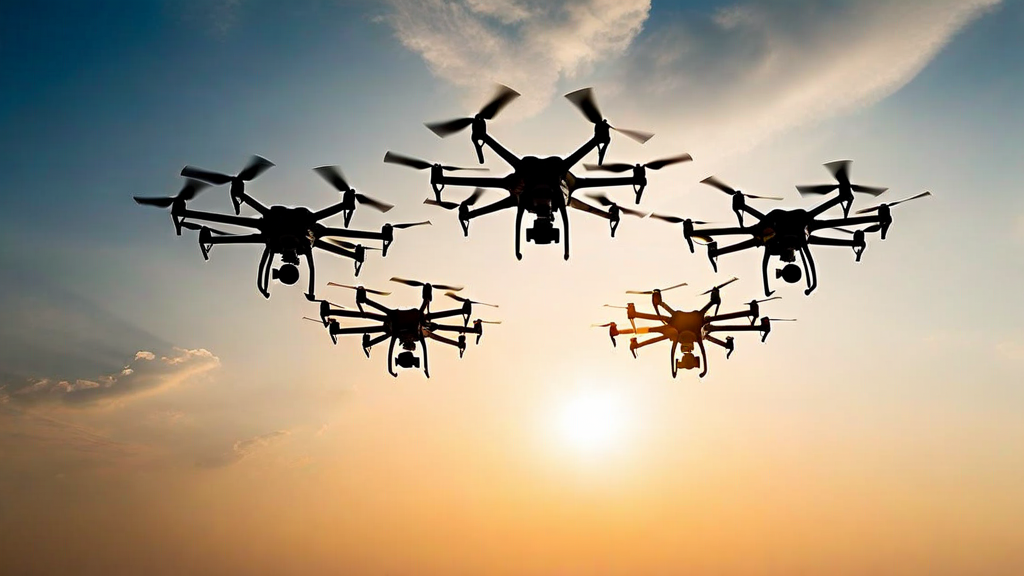
Deploying multiple drones simultaneously to cover large areas or accomplish complex missions more rapidly than a single platform could manage is one of the most compelling directions in commercial UAV development. The operational rationale is intuitive: a fleet of four drones can survey four times the area in the same time as a single drone, or complete the same area in a quarter of the time. The engineering challenge is making that fleet work as a coordinated system rather than a collection of independently piloted vehicles — and doing so in a way that is robust to communication failures, individual vehicle failures, and the unpredictable dynamics of real operating environments.
Multi-UAV coordination is not a single algorithm but a family of related problems: mission planning (how should the available airspace and mission objectives be allocated among the fleet?), collision avoidance (how do individual vehicles maintain safe separation from each other and from obstacles?), communication management (how does the fleet maintain coordination given limited and unreliable communication bandwidth?), and fault recovery (how does the fleet adapt when a vehicle fails or becomes unavailable?). Solving these problems well, and in a way that scales from two-vehicle operations to larger fleets, is the core challenge in swarm system design.
Mission Allocation and Area Decomposition
Area decomposition is the foundational problem in multi-drone mission planning: given a survey area, a set of waypoints, or a set of inspection targets, how should the available work be divided among available vehicles to minimize total mission time or energy expenditure? The answer depends on the spatial distribution of the work, the number and capability of available vehicles, and practical constraints like no-fly zones, battery endurance limits, and the geographic distribution of launch and landing points.
For area coverage missions — photogrammetric surveys, crop monitoring flights, search patterns — the standard decomposition approach is Voronoi partitioning or its variations. Each drone is assigned a sub-region of the total survey area, and its flight plan is generated to provide complete coverage of that sub-region at the required image overlap. The partitioning algorithm seeks to equalize the workload (flight time or battery consumption) across all assigned vehicles, accounting for any asymmetry in vehicle endurance or payload capability. Dynamic reallocation — reassigning work from a vehicle that encounters a fault or exhausts its battery faster than expected to remaining vehicles — is implemented through a centralized mission manager that monitors vehicle state and updates assignments when needed.
Waypoint-based allocation, applicable to inspection tasks at discrete targets, is commonly approached as a variant of the multiple traveling salesman problem (mTSP): assign waypoints to vehicles such that each vehicle visits its assigned waypoints with minimum total path length (or time, or energy), subject to vehicle capacity constraints. For small fleets (2 to 8 vehicles) and modest numbers of waypoints (under a few hundred), optimal or near-optimal solutions can be found through genetic algorithms, simulated annealing, or mixed-integer linear programming solvers within planning time budgets that are practical for pre-mission use.
Collision Avoidance in Multi-Vehicle Operations
Collision avoidance in multi-UAV operations has two distinct components: separation maintenance between fleet members (cooperative deconfliction) and obstacle avoidance relative to the static and dynamic environment (non-cooperative avoidance). Both must function reliably for safe swarm operations, but the technical approaches differ significantly.
Cooperative deconfliction among fleet members is most tractable when flight plans are pre-computed with spatial and temporal separation built in — a approach known as strategic deconfliction. If each vehicle's planned trajectory is shared with all others before the mission begins, separation conflicts can be identified and resolved in the planning phase, and all vehicles can execute their planned trajectories simultaneously without requiring real-time communication-based coordination. Strategic deconfliction works well for planned survey missions but becomes computationally demanding as fleet size grows and requires fast replanning capability when actual vehicle positions deviate significantly from planned trajectories.
Velocity obstacle (VO) and reciprocal velocity obstacle (RVO) algorithms provide a reactive deconfliction approach that computes, for each vehicle, the set of velocities that would result in a collision with any other vehicle within a planning horizon. The algorithm then selects a velocity outside this set that is closest to the vehicle's desired velocity — allowing it to continue toward its objective while avoiding conflict. RVO distributes the avoidance maneuver equally between conflicting pairs, preventing the oscillatory behavior that can occur when a single vehicle bears all the avoidance responsibility. These reactive algorithms are computationally lightweight and can operate at the update rates required for real-time flight control, making them a practical complement to strategic deconfliction for handling deviations from planned trajectories.
Communication Architecture for Swarms
Effective swarm coordination requires that vehicles share state information — position, velocity, battery status, mission progress — frequently enough to support deconfliction and mission management decisions. The communication requirements for small swarms (2 to 8 vehicles) are modest: exchanging 200-byte state packets at 2 to 5 Hz per vehicle pair requires a data rate of a few kilobits per second, easily within the capability of standard drone telemetry radios at ranges up to several kilometers.
Larger swarms face more significant communication challenges. The number of communication links scales quadratically with fleet size in a fully connected mesh — 10 vehicles require 45 pairwise links — and the aggregate data rate required to maintain real-time situational awareness across all vehicles can exceed the available bandwidth of standard radio systems in congested environments. Hierarchical communication architectures, where vehicles communicate primarily with their nearest neighbors and propagate aggregated state information to more distant vehicles, provide a scalable alternative to fully connected meshes at the cost of increased state estimation latency for distant vehicle pairs.
Intermittent connectivity — the inevitable occurrence of communication dropouts due to range, multipath fading, or interference — must be handled gracefully by the coordination algorithms. Vehicles that lose contact with the mission manager or with neighboring fleet members should default to conservative behaviors: maintaining their last assigned trajectory, reducing speed to create more separation margin, or entering a loiter pattern at safe altitude until communication is restored. Designing these failsafe behaviors correctly is as important to safe swarm operation as the primary coordination algorithms.
Task Assignment in Dynamic Environments
Pre-mission task allocation assumes that the mission environment will remain stable throughout execution — an assumption that frequently fails in practice. Wind conditions change, airspace closures occur, vehicles develop faults, and inspection targets reveal additional work requirements that were not apparent from pre-mission planning. Dynamic task allocation algorithms respond to these changes by recomputing assignments in real time as the mission evolves.
Auction-based algorithms are a widely used approach for decentralized dynamic task assignment. When a new task appears or an existing task becomes unassigned (due to vehicle fault or changed priority), the task is broadcast to all available vehicles. Each vehicle computes a bid for the task — reflecting its current position, battery state, and existing workload — and submits this bid to a task manager. The task manager assigns the task to the highest bidder and updates all vehicles' workloads accordingly. Auction algorithms are computationally efficient, scale well to larger fleets, and naturally incorporate vehicle heterogeneity (different vehicles can have different bid functions reflecting their different capabilities).
Consensus-based algorithms provide an alternative where task assignments emerge from distributed agreement protocols rather than centralized auction management. Each vehicle maintains a local estimate of the global assignment state and updates it based on information exchanged with neighbors, converging to a consistent global assignment through iterative communication rounds. Consensus approaches are more robust to central manager failure but require more communication rounds to converge than auction methods, creating a latency disadvantage in rapidly changing environments.
Fleet Fault Management
Individual vehicle failures are a statistical inevitability in any large-scale commercial drone operation. Motors fail, batteries develop faults, and communication links degrade. A swarm coordination system that cannot adapt gracefully to vehicle losses will fail to complete its missions whenever the failure rate exceeds zero, which in practice means every sustained commercial operation. Fault management in multi-vehicle systems requires both vehicle-level fault detection and system-level task redistribution.
Vehicle-level fault detection relies on onboard monitoring of motor current, battery voltage, vibration signatures, GPS quality, and communication link quality. Anomalies in any of these parameters trigger a vehicle-level fault assessment that may result in the vehicle initiating a precautionary return-to-home, reducing speed or altitude, or broadcasting a distress signal to the fleet manager. The specific fault response hierarchy depends on fault severity: a single motor performance degradation may trigger a speed reduction and precautionary mission abort, while GPS failure in a GPS-dependent flight phase triggers an immediate guided return-to-launch using inertial navigation.
System-level response to vehicle loss requires the remaining fleet members to absorb the failed vehicle's assigned tasks. The redistribution algorithm must quickly recompute assignments that are feasible given the current battery states and positions of remaining vehicles, prioritizing the mission-critical tasks from the failed vehicle's plan while maintaining safe separation among the remaining fleet. Response time is critical — delays in task redistribution create coverage gaps that may not be recoverable within the remaining fleet's endurance budget.
Key Takeaways
- Area decomposition using Voronoi partitioning equalizes workload across fleet members for coverage missions; dynamic reallocation handles deviations from planned endurance.
- Strategic deconfliction (pre-planned separation) combined with reactive RVO algorithms provides robust collision avoidance that handles both planned operations and real-time deviations.
- Communication requirements scale quadratically with fleet size; hierarchical mesh architectures provide scalability for larger fleets at the cost of increased state propagation latency.
- Auction-based dynamic task assignment efficiently redistributes work in response to vehicle faults, environment changes, or new task discoveries during mission execution.
- Swarm fault management requires both vehicle-level anomaly detection and system-level task redistribution algorithms to maintain mission continuity across vehicle losses.
- Multi-UAV operations achieve linear speedup in area coverage time (2 drones = 2x faster) when coordination overhead is well-managed through efficient algorithms and reliable communication.
Conclusion
Multi-drone coordination represents the next major capability step for commercial UAV operations after the transition from manual to autonomous single-vehicle flight. The algorithms described here — from area decomposition and collision avoidance through dynamic task assignment and fault recovery — form a complete system architecture for robust swarm operations in industrial environments.
The commercial applications where swarm operations deliver compelling value — large-area surveys, time-critical search and response, and facility-scale inspection programs that require simultaneous coverage of multiple inspection zones — are already being pursued by pioneering operators. As the software maturity of swarm coordination systems improves and the operational complexity of managing multi-vehicle fleets decreases, the proportion of commercial drone operations conducted by coordinated fleets rather than individual aircraft will grow substantially over the next five years.