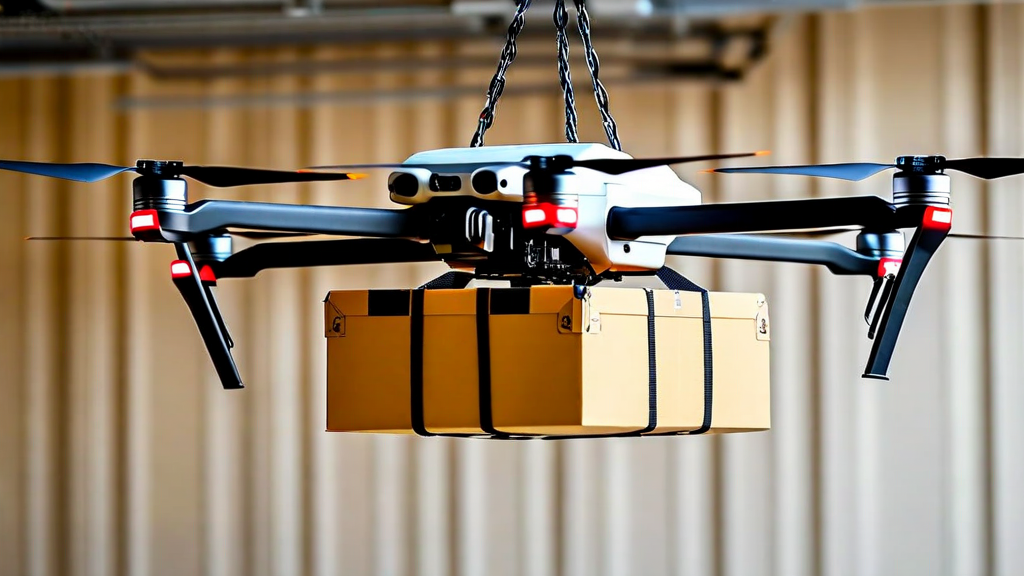
In any aircraft design, the relationship between useful payload, fuel (or battery) weight, empty weight, and performance defines the fundamental capability envelope of the vehicle. For commercial UAVs designed around delivery applications, this relationship is particularly acute: a drone that can carry 1.5 kg of payload to a 10-kilometer range represents a fundamentally different commercial proposition than one that carries 500 grams to the same range, and the engineering decisions that determine which end of that spectrum a design lands on begin in the earliest stages of configuration selection and weight budgeting.
The payload fraction — the ratio of useful payload weight to total all-up-weight — is the primary metric of delivery drone efficiency. Commercial quadrotor delivery platforms achieve payload fractions of 15% to 35% depending on configuration, battery technology, and structural efficiency. The wide range reflects the enormous design sensitivity of multi-rotor aircraft to component weight, where every gram of structure, electronics, or battery saved translates directly to either increased payload capacity at the same range or increased range at the same payload. Understanding the engineering levers available to improve payload fraction, and their tradeoffs, is central to designing competitive delivery drone systems.
Weight Budget Fundamentals
A commercial delivery drone's all-up-weight breaks down into four primary categories: airframe structure (including motors, ESCs, and propellers), avionics and flight controller, battery, and payload. The proportional weights of these categories are not fixed — they vary with design choices across all four — but typical distributions for a mid-class commercial delivery quadrotor in the 8 to 15 kg all-up-weight range are approximately 20 to 25% structure, 8 to 12% avionics, 35 to 45% battery, and 20 to 30% payload at maximum payload capacity.
The battery fraction is the largest single weight category and the most direct determinant of range performance, but increasing battery fraction to extend range comes at the direct cost of payload fraction. A design that allocates 45% of all-up-weight to batteries will carry less payload at a given all-up-weight than one allocating 35%, assuming equal structural and avionics fractions. The optimal battery fraction depends on the specific range-payload requirements of the target application and cannot be determined in isolation from the intended use case.
Structural weight reduction yields a leverage effect that is larger than the weight saved might initially suggest. Removing 100 grams from the airframe structure does not simply reduce all-up-weight by 100 grams if the aircraft needs to maintain the same performance. It allows either the payload to increase by 100 grams at the same all-up-weight, or the all-up-weight to decrease by an amount greater than 100 grams if the design is resized to achieve the same payload at the same range — because smaller motors, smaller propellers, and a smaller battery are now sufficient to carry the lighter structure plus the original payload. This cascading weight reduction effect, known as the "snowball" effect in aircraft sizing, amplifies the value of structural efficiency improvements.
Battery Technology and Energy Density
Battery technology is the most rapidly advancing component category in the commercial drone supply chain, and improvements in cell energy density have a direct and large impact on delivery drone range-payload performance. Lithium-polymer cells commercially available in 2024 for UAV applications offer specific energy in the range of 250 to 280 Wh/kg at the cell level. Lithium-high-voltage (Li-HV) cells operating at peak charge voltages of 4.35V per cell rather than the standard 4.20V achieve 5 to 8% higher energy density than standard LiPo cells at the cost of somewhat reduced cycle life — a trade that is typically acceptable for commercial delivery drones that may cycle their batteries 150 to 300 times per year.
Semi-solid-state lithium cells, which replace a portion of the liquid electrolyte with a gel or ceramic separator, are beginning to reach commercial availability in 2024 with energy densities approaching 400 Wh/kg at the cell level. The improvement in energy density at equivalent cell weight translates to approximately 25 to 35% longer endurance at the same payload, or the ability to carry the same payload to proportionally longer range. The adoption curve for semi-solid-state cells in commercial delivery drones will be driven by cost reduction and supply chain development — cell costs are currently 3 to 5 times higher than commodity LiPo cells — but the energy density advantage is compelling enough that integration into premium delivery platforms is beginning to occur.
Battery Technology Comparison: Standard LiPo: 250–260 Wh/kg. Li-HV: 265–280 Wh/kg (+6–8%). Semi-solid-state: ~380–400 Wh/kg (+50–55%). The energy density trajectory suggests battery-limited delivery range will roughly double over the next 5 years at equivalent weight.
Center-of-Gravity Management
The center of gravity (CG) of the loaded aircraft — the three-dimensional point through which the total weight of the vehicle acts — must remain within a defined envelope relative to the center of lift for stable, controllable flight. For a symmetric quadrotor with fixed motor positions, the center of lift is determined by the motor and frame geometry and is fixed. Payload must therefore be positioned within the airframe such that the loaded CG falls within the acceptable envelope around the center of lift, regardless of payload mass and geometry.
Variable payload mass creates a CG shift challenge that delivery systems must address mechanically. A payload bay designed to accept packages ranging from 200 grams to 1,500 grams will produce different CG locations depending on where within the bay volume the package mass is concentrated. Constraining the CG shift requires either a payload bay geometry that maintains predictable mass distribution — typically by centering the payload support point vertically below the center of lift — or an active CG compensation mechanism that adjusts the battery position to counteract payload-induced CG shifts.
Most commercial delivery platforms use the simpler approach of a constrained payload bay design that places the payload attachment point directly below the airframe CG, accepting that the loaded CG will shift downward as payload is added but remaining along the vertical axis. This is acceptable for quadrotor aircraft because the flight controller can compensate for modest CG shifts through differential thrust adjustment, but very large CG offsets — those exceeding 15 to 20% of arm length — cause sustained trim deflections that reduce efficiency and limit maneuverability.
Propulsion System Sizing for Variable Payloads
Commercial delivery drones must maintain acceptable flight performance across the full payload range from unloaded (return trip) to maximum payload (outbound trip). Motor and propeller selection must account for this range of all-up-weights while maintaining adequate thrust margin at maximum payload and acceptable efficiency in the lighter unloaded configuration.
Thrust margin — the ratio of maximum available thrust to the thrust required to hover — is the primary safety parameter in motor sizing. Industry practice for commercial delivery platforms requires a minimum 2:1 thrust-to-weight ratio at maximum all-up-weight, providing sufficient margin for attitude control authority and wind rejection. A lower thrust margin reduces the aircraft's ability to maintain position and attitude in wind, and eliminates the reserve needed to execute emergency landing procedures following a motor or ESC partial failure.
The efficiency penalty of flying an unloaded delivery platform is a real operational cost that affects battery consumption on return trips. A quadrotor sized for maximum payload operation at 2:1 thrust margin will be operating its motors at well below their efficiency peak when returning unloaded — motors optimized for high-thrust operation are typically less efficient at the lower thrust levels required for unloaded hover. Some commercial operators address this by using variable-pitch propellers that allow the same motor speed to be maintained across a wider range of thrust requirements, improving hover efficiency under the light load of the unloaded return trip.
Thermal Management in High-Cycle Operations
Commercial delivery operations involve repeated cycles of loading, launch, cruise, descent, and landing — sometimes at rates of 8 to 15 cycles per day for high-utilization platforms. This cycling creates thermal management challenges for the motor and ESC systems that are not encountered in lower-frequency inspection or survey operations. Motor windings heat up during flight, and insufficient cooling between cycles can result in winding temperature buildup that degrades motor efficiency, accelerates insulation aging, and ultimately causes premature motor failure.
Delivery drone motor and ESC thermal design must account for the steady-state temperature achieved at the end of a representative duty cycle, not just the temperature reached on a single flight. Air-cooled systems rely on the propeller-induced airflow over the motor bell and stator to maintain winding temperature within rated limits — a cooling mechanism that is effective in flight but largely absent during ground time between missions. Passive thermal storage in the motor mass provides some buffer, but operations at high cycle rates in warm ambient conditions may require active cooling or enforced cooling intervals between missions.
Key Takeaways
- Payload fraction (useful payload / all-up-weight) is the primary efficiency metric for delivery drones; commercial quadrotors achieve 15–35% depending on design optimization.
- Structural weight reduction has a cascading "snowball" amplification effect: each gram removed from structure enables disproportionate reduction in the motor, propeller, and battery sizing required for equivalent performance.
- Li-HV cells provide 6–8% energy density improvement over standard LiPo; semi-solid-state cells approaching commercial availability offer ~50% improvement at proportionally higher cost.
- CG management requires payload bay geometry or active compensation mechanisms to maintain trim within the flight controller's correction capability across the full payload range.
- Minimum 2:1 thrust-to-weight ratio at maximum all-up-weight is the industry standard safety margin for commercial delivery platforms.
- High-cycle operations require explicit thermal management design for motors and ESCs — steady-state temperature at mission completion, not single-flight peak, drives thermal ratings.
Conclusion
Payload optimization in commercial delivery drones is fundamentally a systems engineering challenge: the weight budget, battery selection, structural design, propulsion sizing, and CG management decisions are deeply interdependent and must be resolved simultaneously to achieve a coherent, balanced design. Optimizing any single dimension in isolation — maximum battery capacity, minimum structural weight, or maximum motor thrust — without considering the interactions with other design parameters consistently produces suboptimal outcomes.
The delivery drone programs that achieve the best route economics are those built on disciplined weight budgets, proven cell chemistry selections calibrated to their specific range-payload requirements, and robust CG management strategies that maintain safe flight characteristics across the full operational load range. As battery energy density continues to improve and structural materials continue to mature, the performance envelope available to commercial delivery programs will expand — but the engineering discipline required to fully capture those improvements will remain constant.